Why Your Roof Only Leaks After Heavy Rain
You know how frustrating it is when your ceiling stays perfectly dry for months, only to turn into a sieve the moment a real storm hits.
We see this constantly in the Northern Suburbs—a roof handles light winter drizzle without a single drip, but a heavy August downpour changes everything.
It is a specific type of failure that catches many Perth homeowners off guard, especially after the record-dry spells we saw in 2024.
Suddenly, you are scrambling for buckets.
This article explains why that happens and, more importantly, how we fix it for good.
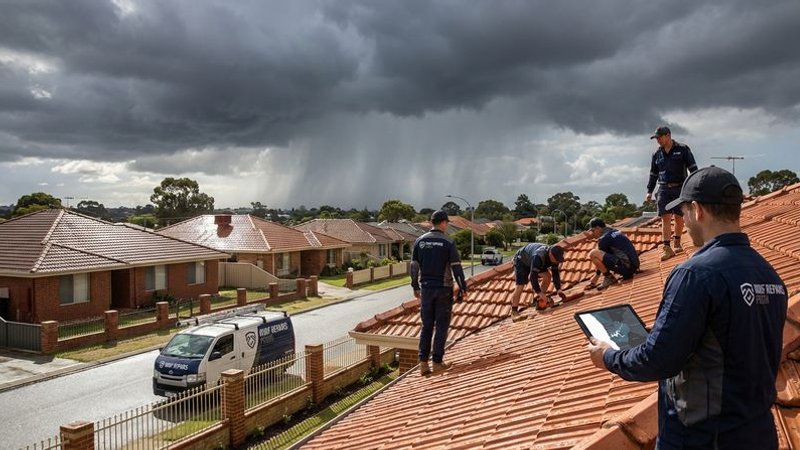
The “Hydrostatic Pressure” Tipping Point
Most people assume a roof is either waterproof or it isn’t.
But the reality is that many older roofs in suburbs like Duncraig and Carine are only “water-shedding,” not fully waterproof.
They rely on gravity to pull water down faster than it can seep in.
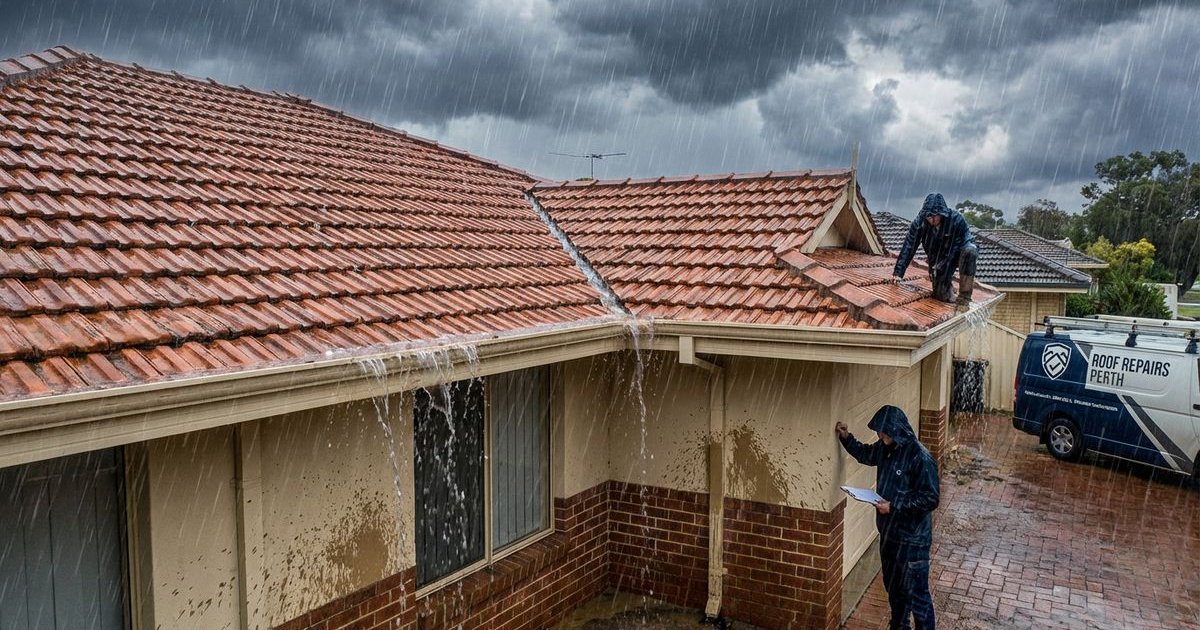
When a standard winter shower hits, water flows passively over the tiles and into the gutters.
However, during a high-intensity storm—where rainfall exceeds 100mm per hour—gravity is no longer enough.
We call this the hydrostatic pressure tipping point.
The sheer volume of water backs up because it cannot drain fast enough, creating pools on your roof that force liquid into gaps that are normally safe.
A tiny hairline crack that repels a drizzle becomes a high-pressure injection point during a storm.
Why It Only Happens Now (The Causes)
1. Wind-Driven Rain (The Coastal Factor)
If you live in coastal areas like Hillarys, Mullaloo, or Mindarie, you are familiar with the “horizontal rain” that comes off the Indian Ocean.
Standard roof tiles are designed to stop water falling down, not water traveling sideways or up.
Strong north-westerly winds can push water uphill under the laps of your tiles, bypassing the drainage channels entirely.
We often find that leaks in these suburbs correlate perfectly with wind direction—if the storm blows from the ocean, the leak appears; if it blows from the land, you stay dry.
2. The Valley “Fail Point”
Roof valleys are the metal channels where two sections of your roof meet, and they take a beating during heavy storms.
In many 1980s and 90s homes in Kingsley and Woodvale, these valleys are still the original galvanized iron.
Over decades, they develop pinhole rust that doesn’t leak during a light shower because the water moves too fast.
But heavy rain fills the valley to the brim.
Once the water level rises above those rust spots or overflows the “lip” of the valley due to debris, it pours directly into your ceiling cavity.
3. Ridge Capping Fatigue
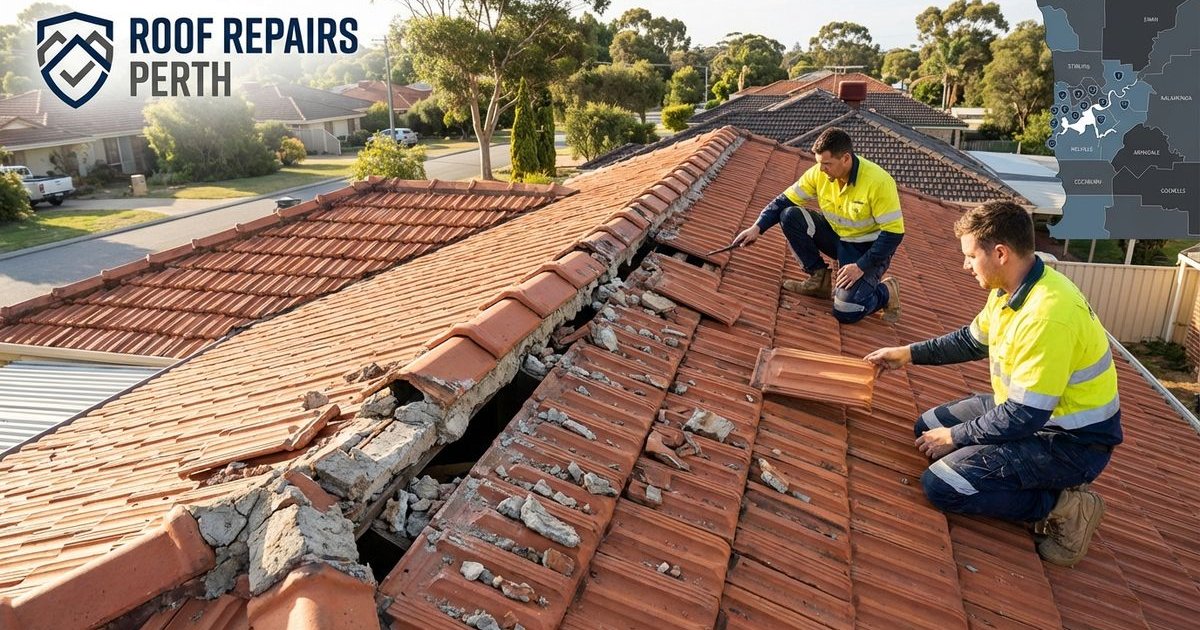
Your ridge capping is the cement bedding that holds the top row of tiles in place.
Old-school cement mortar is rigid, which is a problem in Perth’s climate where temperatures swing from 40°C in summer to 2°C in winter.
This thermal shock causes the rigid cement to crack and detach from the tiles.
We find that during light rain, the water just runs over these cracks.
In a deluge, however, water pools against the ridge line and is forced through those fissures by the wind.
If you haven’t had your ridge capping re-pointed in the last 10 years, this is your most likely culprit.
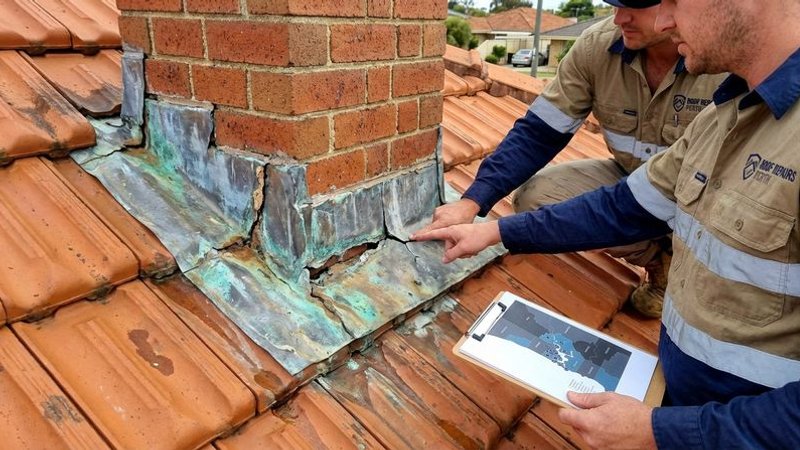
4. Flashing Failures
Flashing is the metal seal around penetrations like chimneys, vent pipes, and skylights.
Lead flashing was the standard for years, but it has a nasty habit of splitting as it ages.
Light rain might not reach high enough to enter these splits.
A heavy downpour, however, submerges the flashing, allowing water to flow freely through the tear.
5. The “Sponge” Effect (Capillary Action)
This is a tricky one that often gets missed by general handymen.
When two surfaces are pressed closely together—like the overlap of two tiles—water can actually be sucked upwards against gravity.
This phenomenon is called capillary action.
It only happens when there is enough water volume to bridge the gap between the tiles.
We see this frequently with concrete tiles that have lost their glaze and become porous; they absorb water like a sponge until they reach saturation, at which point they start dripping inside.
6. The Norfolk Island Pine Problem
In suburbs like Cottesloe and Sorrento, the majestic Norfolk Island Pine is a roofing nightmare.
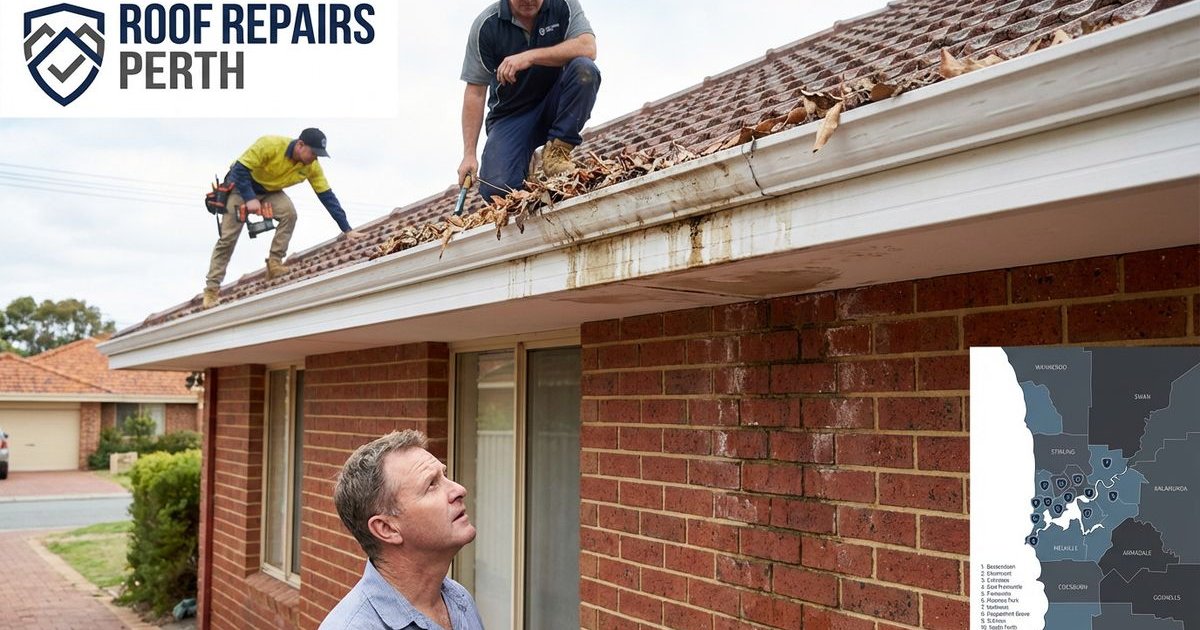
Unlike broad leaves that blow away, pine needles weave themselves into a dense, water-retentive mat in your gutters and valleys.
This mat acts like a dam.
When heavy rain hits, the water can’t exit the gutter, so it backs up under your eaves and flows inside your walls.
7. Missing Sarking in Pre-1990 Homes
Sarking is the silver foil or blue membrane that sits under your roof tiles.
It acts as a second skin—if a tile leaks, the sarking catches the water and runs it into the gutter.
Building codes in WA didn’t mandate this for all homes until the early 90s.
If your home was built before then, you likely have zero backup protection.
This means the first drop of water that gets past a tile goes straight onto your insulation.
Professional Diagnosis: How We Find It
Tracking a heavy-rain leak is investigating a crime scene after the evidence has dried up.
Water often enters at the peak of the roof, runs down a rafter for five metres, and then drips onto your ceiling in a completely different room.
Here is how we pin it down:
- Roof Space Forensics: We enter the roof cavity (safely) to look for water trails on the timber trusses, which often leave tell-tale mineral stains.
- Moisture Mapping: Using thermal cameras and moisture meters, we can detect dampness in insulation even days after the rain has stopped.
- Hydrostatic Simulation: In some cases, we use a hose to simulate heavy rainfall on specific sections of the roof to recreate the leak under controlled conditions.
- Tile Integrity Check: We manually inspect tiles for ” fretting” (crumbling) and hairline cracks that are invisible from the ground.
If you need a definitive answer, booking a professional leak detection repair is the fastest way to stop the guessing game.
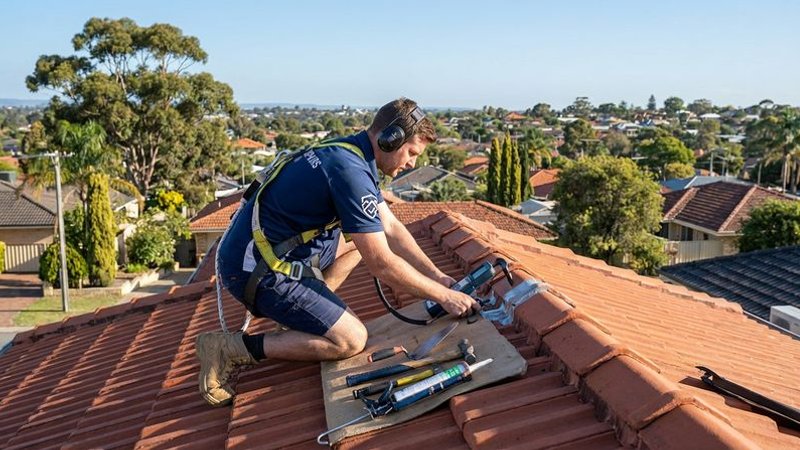
The Fix: Band-Aid vs. Cure
You have options when it comes to repairs, but they aren’t created equal.
We believe in transparency, so here is a comparison of common fixes versus the long-term solutions we recommend.
| Issue | The “Quick Fix” (Temporary) | The “Pro Solution” (Long-Term) |
|---|---|---|
| Ridge Capping | Patching cracks with silicone | Full re-bedding and flexible acrylic pointing |
| Rusty Valley | Painting over the rust with bitumen | Replacing with new Colorbond or Zinc valley irons |
| Broken Tile | Gluing the tile back together | Replacing with a matched tile from a salvage yard |
| Blocked Gutter | Cleaning just the downpipe | Installing continuous gutter mesh (specifically for fines) |
The Value of Flexible Pointing
Modern roof repairs have moved away from rigid cement.
We use flexible acrylic pointing compounds (like Starpoint or Roofbond) that are designed to move with your roof.
This material expands and contracts with Perth’s heat, meaning it won’t crack when the temperature drops 20 degrees in a single night.
It essentially “rubberises” your ridge line, making it impervious to wind-driven rain.
Do Not Wait for the Next Storm
It is easy to forget about a leak once the sun comes out and the ceiling dries.
But water damage is cumulative.
Every time that heavy rain gets in, it rots timber battens, ruins insulation effectiveness, and risks shorting out electrical wiring.
We recommend getting your roof inspected during the dry spells—it is safer for our team and ensures you are watertight before the next front rolls in from the coast.
Secure your home now, and enjoy the sound of rain on your roof without worrying about where it’s dripping.
Need Help with Your Roof?
Get a free inspection and quote from Perth's trusted roof repair specialists. No call-out fee.